2124 – Introduction to China’s mysteries (dezarticast 2022)

Out of respect for the majority of our (English-speaking) visitors, I tried to avoid posting Romanian language materials or RO posts. This time I am making an exception – here is a recent talk on the Romanian Youtube Channel Dezarticulat666 I was invited to participate in. They also have a Twitch channel if you practice this sport. Dezarticast has a mind-blowing diverse range of topics, generally focusing on media, environmental politics, environmental justice, labor rights, cultural labor, the so-called ‘creative industries’, openly discussing working conditions, unionization, exploitation and political economy. What I consider vital is their post-ironic, mediatic and tech-savvy approach to all of the above – I think today it is counter-productive (even suicidal) to not be able to discuss current politics, militarism, refugee crisis, populism without taking into account sucy media as comics, movies, musical videos or web03, tech solutionism or crypto scams, or radical UFOlogy, algo-empowered haterizm or meme magick.

While the discussions was free floating and provocative, sure to be controversial take on a few hot topics in today’s multipolar world, there’s a lot left out to be covered in future podcasts, with different guests & and their experiences. I feel highly indebted to A. Rautoiu for making the invitation and for editing the final material. Here is some of the things discussed:

00:00:00 – Intro

00:06:07 – The mazine „New China” (here is a resource of China Reconstructs mag) from the 1980s

00:09:00 Chinese mass culture in the 1980s Romania

00:12:05 – the 2008 Financial Crisis and how Adi Schiop became interested in China

00:21:03 – Sinophobia and the COVID-19 pandemics

00:22:43 – multidimensional China

00:23:31„Maoism a Global History” by Julia Lovell

00:26:10„How China Escaped Shock Therapy” by Isabella M. Weber

00:27:06 – Other informational sources about China

00:30:12 – The polycrisis of today’s China

00:35:43 Chaoyang Trap

00:37:55 – Romanian translations from Chinese literature authors

00:40:12Chinese SF, especially Liu Cixin

00:47:20 – The way the CCP incorporates criticism & dissent

00:50:41 – Dissidence and popular resistance against the party

00:56:52 – China’s relation with the rest of the world as compared to now

01:03:01Maoism in the rest of Asia

01:06:54 – Asian states that developed under dictatorships (including a dirigiste tech leveraging by state institutions establishing development goals in Japan, Taiwan, Singapore, South Korea)

01:10:34 – Sinophobia in a larger context of anti-Asian xenophobia

01:16:24 – Conclusions

Other China resources:

Sixth Tone (news culture, politics, trends, economy, trends, etc.) this is one of the few very good portals on lots topics including LGTBQ+ and feminist issues as well as daily aspects of life in China.

Sofia Horta’s TW (Bloomberg) weekly thread on China’s economy, policies, stocks, trends her bombardmenf article again gives me the impression that it’s about China’s importance (or risk management) in Western (investors) eyes, still its vital to keep track and put on these “glasses”.

Global Times (PRC official positions, foreign policy, analysis, etc) it might seem like opaque if one does not actually read btw the lines, yet again it is one of these rare insider perspectives. It also offers quick short 3m videos with recent news (similar to Scmp). Invaluable as to official party line I would say.

South China Morning Post (news portal, international and China news, HK Asia and China focused) as Adi S s-a d its already part of the Alibaba consortium and has a certain independence and works as permitted alternative to the above.

Discourse Power substack (by Tuvia Gering a research fellow at the Jerusalem Institute for Strategy and Security, a non-resident fellow at the Atlantic Council’s Global China Hub, and a Tikvah’s Krauthammer Fellow, specializing in Chinese security and foreign policy, and emergency and disaster management.). It’s about ‘discourse power’ – and how this is becoming a job advertising the capacity to read China’s entrails. I am pretty cautious of such efforts (since there’s always a bidding going on) but i appreciate the translation effort.

2123 – SFitze 05 (substack)

If you’re interested in more SFitze issues please subscribe, support or share with others. This is a newsletter about mundane, banal and absurdist SF happenings all around, recognized or not. As SF melts into thin air – it infuses the forces of production, commercial culture, pop iconography, and comics as well as the mundane-as-fuck growing category. Think about the unbearable lightness of billionaires in space and presidential candidate Mélenchon projected as hologram in several cities during the recent French elections (thx Ion D. for this one) but also about Muslim teens and China’s nascent green hydrogen sector. SFitze is about how to trace SF spillovers independent of scale. Two things I’ve come to appreciate: never be dismissive and also never accept SF labels or outright denials thereof (“this is SF or this has zero to do with SF”). As the email version is shorter than the original one please scroll down the original substack post.

2122 – The world’s most hated art style (struthless 2022)

“The story of Corporate Memphis, aka “Alegria”, aka the big tech art style.” (YT channel)

My thanks to A. Rautoiu for tracking this – history of Corporate Memphis. I urge you to read his longread article for the Romanian tech news Mindcraft stories (use Google Translate – works pretty well). He offers both an in-depth view on how ML works and how it does not work and how artists and creative work is not just endangered by AI art (like DALL-E and GPT-3 but suffering from its own chronic commercial pressures to fit into the new algorithmic capitalist world (be easily recognizable, get ranked by search engines etc.). At the same time, he does not foreclose the potential of AIs and both human-algo collaborative work to be satisfying and actually rewarding, although this depends on more than just full automation and Metaverse subsumption. It is also a question of training – swallowing all these huge databanks, making use of all these free public (public domain) data being used to train algorithms that are the private propriety of big tech companies.

The history of Memphis Corporate – is not a rare outlier, it actually describes how the general intellect has been privatized and copyrighted nowadays without any regard to its various sources. It is not just that the original artists are being disrespected or completely outsourced and deleted – but an entire previous history of design under contemporary cartelization has been completely rewritten under this new corporate revisionism. You see why the whole history of art is somehow a long history of struggle for recognition and why the under-representation of artists and their work is all around us. Creative Industries have been built on these sorts of deletion.

2120 – Red Modernism: The Films of Miklós Jancsó  (Red May 2022 discussion)

“One of the most acclaimed Eastern European directors of the late 1960s, Miklos Jancsó became known for his abstract long-take style which explored the intersections of power, politics, history, and myth. (“Radical form in the service of radical content,” as the Village Voice film critic, James Hoberman, put it back then.) Now that the Beacon Cinema in Columbia City is hosting a retrospective of six of his films (including Red Psalm, which won him the best director prize at the 1972 Cannes Film Festival), Red May has invited three film scholars–Eszter Polonyi, Zoran Samardzija, and Steven Shaviro—to discuss Jansco’s boldly stylized film language with Tommy Swenson, Film Curator of the Beacon Cinema“. (YT channel)

Among the films by Miklos Jancsó discussed:

The Round-Up (1965) The Red and the White (1967) The Confrontation (1968) Winter Wind (1969) Red Psalm (1971) Electra, My Love (1974) as well as many of his later (ignored by the Western film publics and critics) from the 80s and 90s.

short made on the occasion of the new 4K restorations of six films by the Hungarian master are touring select cities before coming to Digital, Blu-ray, and DVD.

As a person from the former East – I find it both satisfying at the same time – when one of the most important film directors to have come from Eastern Europe gets the due recognition and sparks such fruitious exchanges as the above (hosted by Red May red arts, red theory, and red politics show from Seattle) – and also frustrated by the fact that his movies are tough to find/watch on the net. I am also emboldened to post this here – as we live at a time where the East and West left seem irredeemably split around Russia’s aggression of Ukraine. There are many receptions of his Jancso’s films – both in the West (in France in particular) as well as different reception in the West than from his native Hungary (as Eszter Polonyi makes amply clear above). It is impossible to give due attention to all what’s been discussed above but here are are some attempts:

  • One cannot split Jancso’s oeuvre into his modernist middle works appreciated by Western film critics (roughly 60s and 70s) from his early more social realist documentaries (one would say ‘progagandist’ 1950s work). He is not anti-system but part of the system while still continuing the negative dialectics. Although it is about two different media (one is cinema and the other painting) and different historical periods I still see here a similarity with the late-reception of Hans Matthis-Teutsch work and the selection mechanism that has somehow frozen a canonic take of him. I think that the reappraisal of the work of avant-garde Hungarian-Romanian painter Hans Mattis-Teutsch by visual artist and researcher Szilárd Miklós during a show at Scena9 BRD and Lajos Kassák Museum in Budapest comes close to how commercial galleries and art collectors have tended to separate or recover (and sell): the avant-garde core. All the questions about a (red) modernist art that has been supported by the state institutions during the Socialist times put his work apart from his modernist peers in the West. The art cinema enclave of the West modernist directors worked against and outside the Hollywood system (Godard, Antonioni, etc.). There is also – the possibility that Jancso would not have the same reception at Cannes today – considering the fact that today’s art cinema has become a sort of globalized product in itself (Zoran Samardzija).
  • Miklos Jancsó’s work is not at all easy to place, even if influenced by Antonioni, it does stand on its own. It is doubly interesting because it is made not in a reactionary frame, but as a critique (Miklos Jancsó is a pessimist) from the LEFT of the Socialist project without renouncing critique by envisioning that a better or another world is possible.
  • Formally he is also unique (following the points made by Steven Shaviro and others on the panel). There is nothing comparable even if one can pick on contemporary work by Lazlo Nemes or Bela Tarr. In the way he combines the fluidity of time-space Miklos Jancsó where free rhythmicities exist (“the life of matter”) with being both rigid and formalist plus having a political power structure overlay, it is hard to find similarities or attach him any labels. With his long-take his cinema work appears related to the minimalist slow cinema – yet he is doing something completely different (from Chantal Ackerman in Jeanne Dielman) because there is a lot of going on, a lot of uncontrollable (documentarian? – as Eszter put it) elements, animals going in and out of the frame and basically a lot of things happening at the same time.
  • Some of Jancso’s work in Hungary comes close to the NSK/Laibach 1980s way that confronted the Yugoslav state not with its ‘humanistic’ or anti-nationalist side but with its nationalistic and authoritarian side (an edge that was later lost during the post-1989 Yugoslav wars). There is something even an ironic attitude similar to the post-modern use of irony in his later movies. These contradictions and refusal of easy closures (or synthesis) can be followed in his less known, Italian movies – that seem much less elaborate and low-budget than his Hungarian ones (La tenica del rito, Rome wants another Caesar).

2119 – Raji: An Ancient Epic (2020 video game)

spacetime coordinates: medieval Rajasthan

tumblr_76b8892cd3f0df06978e58c5661da363_7c84efb3_1280

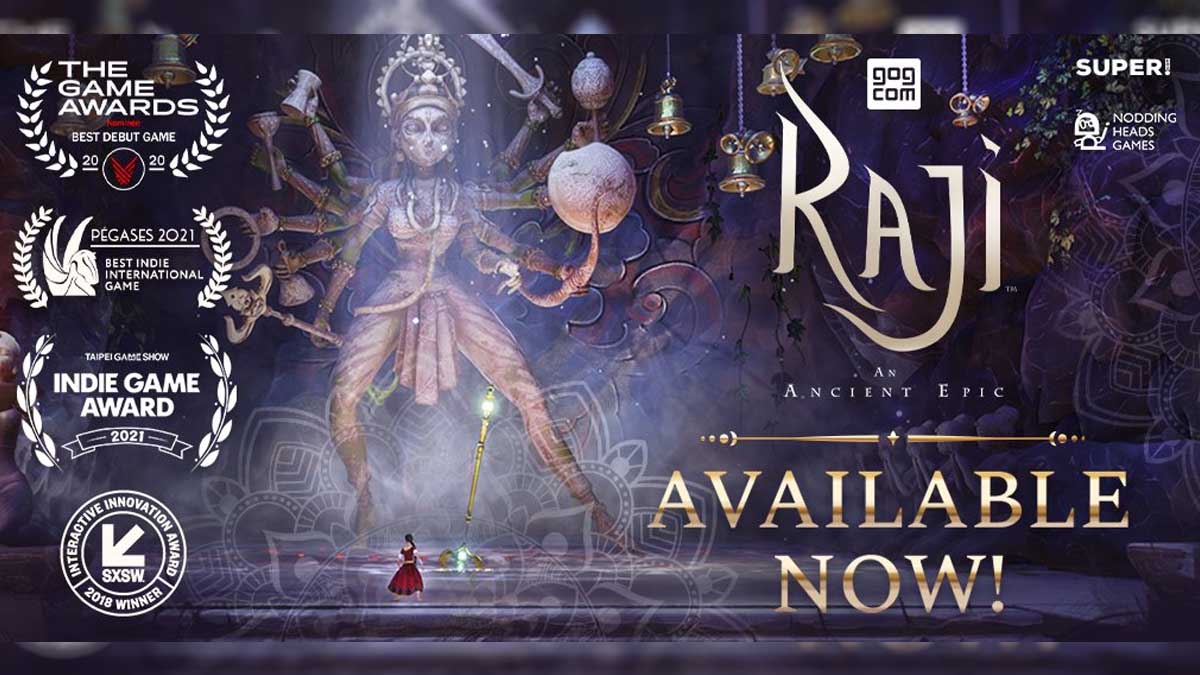
Raji: An Ancient Epic is an Indian action-adventure video game developed by Nodding Heads Games based in PuneMaharashtraIndia. It was first released as a timed exclusive for Nintendo Switch on 18 August 2020, and released on 15 October 2020 for Microsoft Windows via the Steam client and the Epic Games Store, PlayStation 4, and Xbox One.

The game incorporates Hindu mythology and takes inspiration from epics such as the Mahabharata and Ramayana. Graphically, the game is designed in the style of Pahari paintings, and the in-game architecture is modeled after that of medieval Rajasthan. (wiki)

0_Q2QIpTxDAVw3-8vt

raji-an-ancient-epic-lands-on-gog-nodding-heads-games-2021-roadmap230321091406

SYSTEM REQUIREMENTS (MINIMUM): OS: Windows 7 64-bit / Processor: Intel Core i5-4400 (3.1 GHz) / AMD FX-6300 (3.5 GHz) / Memory: 8 GB RAM / Graphics: GeForce GTX 760 / AMD Radeon R9 270 / DirectX: Version 11 / Storage: 6 GB available space / Sound Card: On board

steam

2118 – Rubikon (2022)

spacetime coordinates: 2056 on board of RUBIKON space station

MV5BYmZjNjIyNjMtODgzNC00NmI3LWIxM2QtZGZjYjEyODUyY2IyXkEyXkFqcGdeQXVyMTE1MzI2NzIz._V1_

Rubikon is a 2022 Austrian science-fiction thriller film directed by Magdalena Lauritsch starring Julia Franz Richter, George Blagden and Mark Ivanir.

imdb